
My PhD project reflects my work in Canada at the intersection of non-urban and semi-rural place-led participatory design and social innovation. It explores how we design better ways for communities to shape their own liberatory futures.
This work contributes to the field of Informatics by reframing how we understand social innovation and its role in system change within the context of the discipline. Rather than treating social innovation as a series of isolated interventions, my research will position social change as an ongoing, relational process that requires new ways of thinking and new types of shared infrastructure to mobilize information.

In this framing, the challenge is not simply to design better solutions, but to design the conditions through which diverse actors can continuously make sense of complexity together. This shifts the focus from outputs to processes, and from organizations working in silos to more collaborative forms of coordination across social, economic, and institutional actors.
My research explores game-making, using the Design Games Framework, as a methodological bridge between design and system spaces. This approach offers an alternative to dominant models of socio-technical innovation that rely on abstraction, linear planning, or data-driven optimization. Through experiential and participatory methods, it engages situated forms of knowledge production where complexity can be explored directly rather than simplified. In these contexts, participants can surface interdependencies, test assumptions, and experiment with new forms of coordination that are difficult to access through discussion or analysis alone.
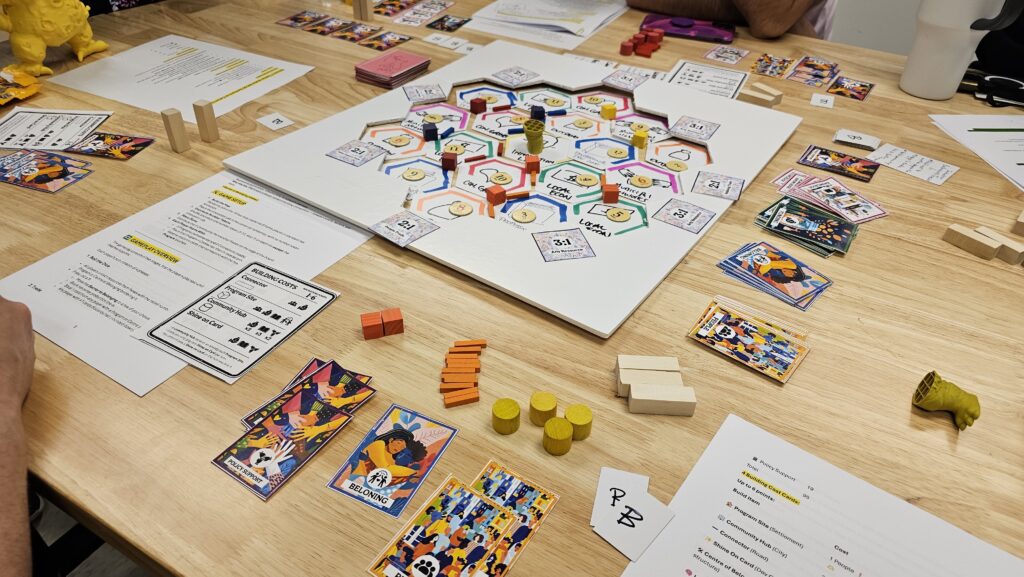
In doing so, this research aims to contribute to a new methodological direction for social innovation, one that supports more adaptive, inclusive, and place-responsive forms of coordination. It also aims to extend the definition of social innovation within the field of Informatics by emphasizing relational and experiential dimensions of system design, where knowledge is not only represented, but embodied.

Leave a Reply